
USE THE POWDER JOURNAL TO ANSWER: How was it? Where were you?
Share route specific conditions & avalanche dangers so that collectively we can stay safer and have more fun!
"Peak a Week" with Brian Lazar of AIARE | UNITED STATES, COLORADO | 12/06/2010, by AlpineAmbitions
“Peak a Week” is a Skiing the Backcountry exclusive series. Hosted by Donny Roth, owner of Alpine Ambitions, the idea is to provide some insight into the process of backcountry skiing. Each episode will feature a new mountain and a new guest. There will always be an educational element that highlights a critical piece of the day. There will be no daring feats of stunning athleticism. Rather, it is meant to inspire the average recreational skier to get into the backcountry.
Colorado’s snowpack is notoriously dangerous. This danger begins with the snow that falls early in the season. Skiing safely in the backcountry means having a clear picture of the snowpack in a three dimensional image. There is no substitute for getting out and poking around in the snow.
Early in the season, I always dedicate a few days to going out to simply look at snow – particularly below the surface. I couldn’t think of a better person to spend a day with than Brian Lazar. Brian is the executive director for the American Institute of Avalanche Research and Education (AIARE), and the assistant director of the Colorado Avalanche Information Center (CAIC). Could there be a better person with whom to go analyze snow?
We decided for a tour to Woodland Mountain located in the Indian Peak Wilderness Area, west of Boulder, Colorado. Woodland Mountain is just over 11,000’ in elevation, and parking at just under 9000’ gives one relatively easy access. It’s a little long on mileage; but it’s well traveled and in the trees, so it’s pleasant even if the wind is a little cranked up.
Skinning up the north side is a pretty steep. We climbed up through the trees and wound our way through some rock outcroppings. It was a great chance to feel the snow as it fell on a variety of terrain features. We were constantly poking out poles as deeply as possible to feel the different layers.
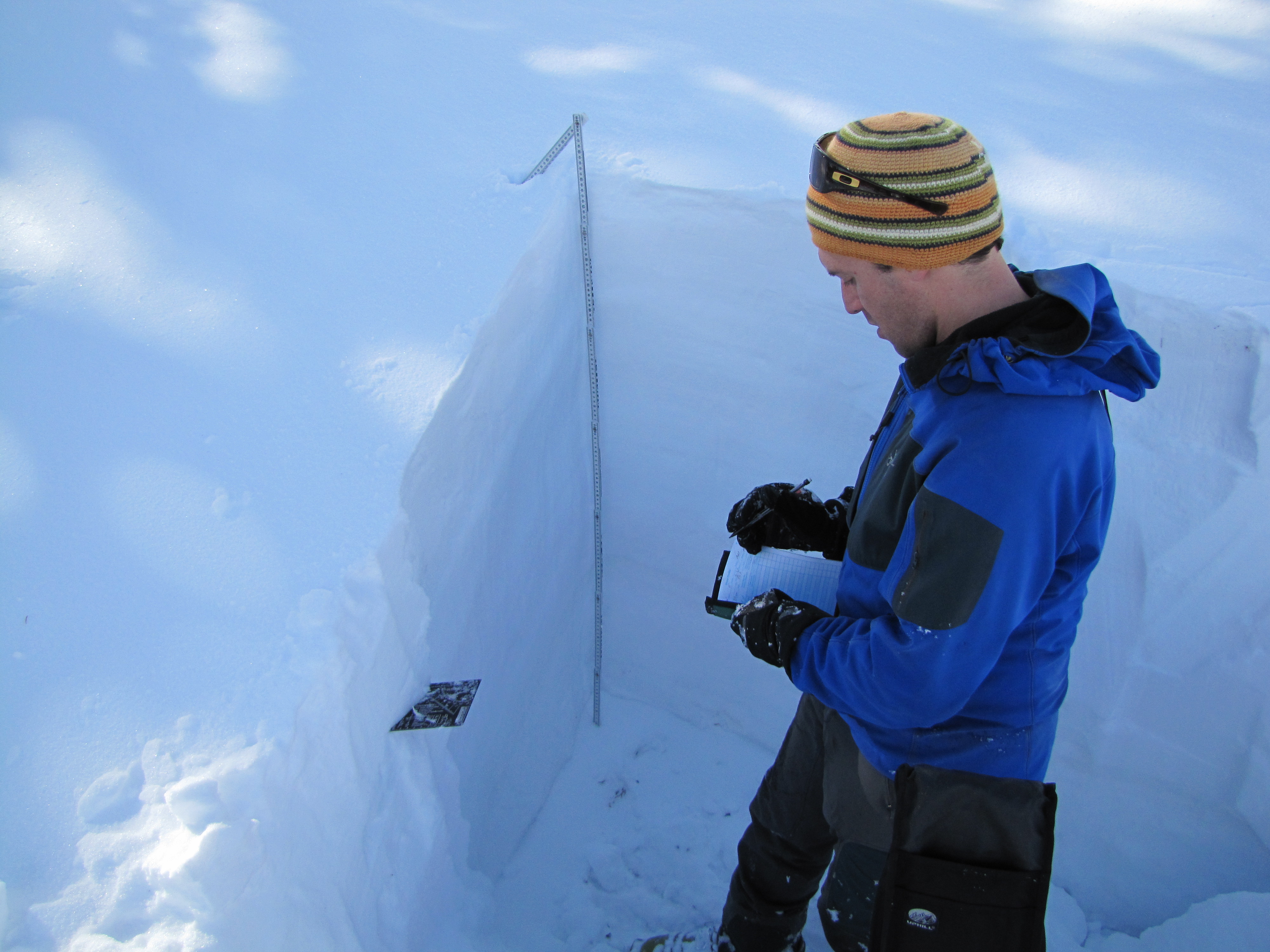
Once we got near the top, we stopped to dig a proper snow pit. We documented the layers, and some of their key properties. It was great to see more than a meter of snow on the ground. It’s only early December! We did a series of compression tests, which confirmed reports that we already had. There is a stiff slab, which is fairly reactive, near the surface. (You can see this in the video.) This layer is definitely supportive of a skier’s weight, so it is really easy to get suckered into being over confident. There is no doubt that it “feels bomber.”
We decided to ski smaller terrain features, and avoid any big, open faces. While we were slightly confined, the up side was creamy turns with a little new snow on a smooth, supportive surface below. It was certainly worthwhile.
Being able to analyze the snowpack allowed us to maximize our fun that day, and we never felt we were taking a risk. If you want to learn more about snow safety, take an avalanche education course – preferably one endorsed by AIARE. If you live in Colorado make sure you check out SkiingtheBackcountry.com and the CAIC for up-to-date conditions.
If you get out a lot, write down your observations (and record them on the Powder Journal) to paint a better picture in your mind. If you don’t get out often then make sure you read the reports diligently and then go looking for evidence.
Safe travels. Enjoy the turns you’ve earned!

